Incubation periods vary from a couple of days to a couple of months, and the more important point is that most infections at most sites never produce symptoms at all. These timings are useful for interpreting something that has appeared rather than for deciding when to test.
Gonorrhoea
Two to fourteen days where symptoms occur, usually within a week. In the urethra that can mean discharge and burning. At the rectum and throat, which is where most infections in men who have sex with men occur, it is silent in the great majority of cases.
Chlamydia
One to three weeks where symptoms occur, and most of the time they do not. Rectal chlamydia is almost always asymptomatic. This is the commonest bacterial infection and the one least likely to announce itself.
Syphilis
The initial sore appears roughly nine to ninety days after exposure, most often around three weeks. It is usually painless, frequently internal and easily missed, and it heals on its own while the infection continues. A rash and flu-like symptoms can follow weeks to months later.
Herpes
Two to twelve days for a first outbreak, though a great many people never have a noticeable one and only discover it years later, if at all. Recurrences are usually milder and preceded by tingling or nerve pain.
HIV
Seroconversion illness, where it occurs, is typically two to four weeks after exposure: fever, sore throat, rash, swollen glands, aching. It resembles flu or glandular fever and is easily attributed to something else. Many people have nothing noticeable at all, and afterwards there may be no symptoms for years.
Mpox
Around five to twenty-one days. Lesions are firm and deep with a dimpled centre, and severe rectal pain is a common presentation. Ring the clinic before attending rather than turning up.
Hepatitis
Weeks to months, and frequently nothing. Acute hepatitis C is silent in the great majority of cases. Hepatitis A and B can cause fatigue, nausea, abdominal discomfort, dark urine and jaundice, and can equally pass unnoticed.
Why are testing windows longer than incubation periods?
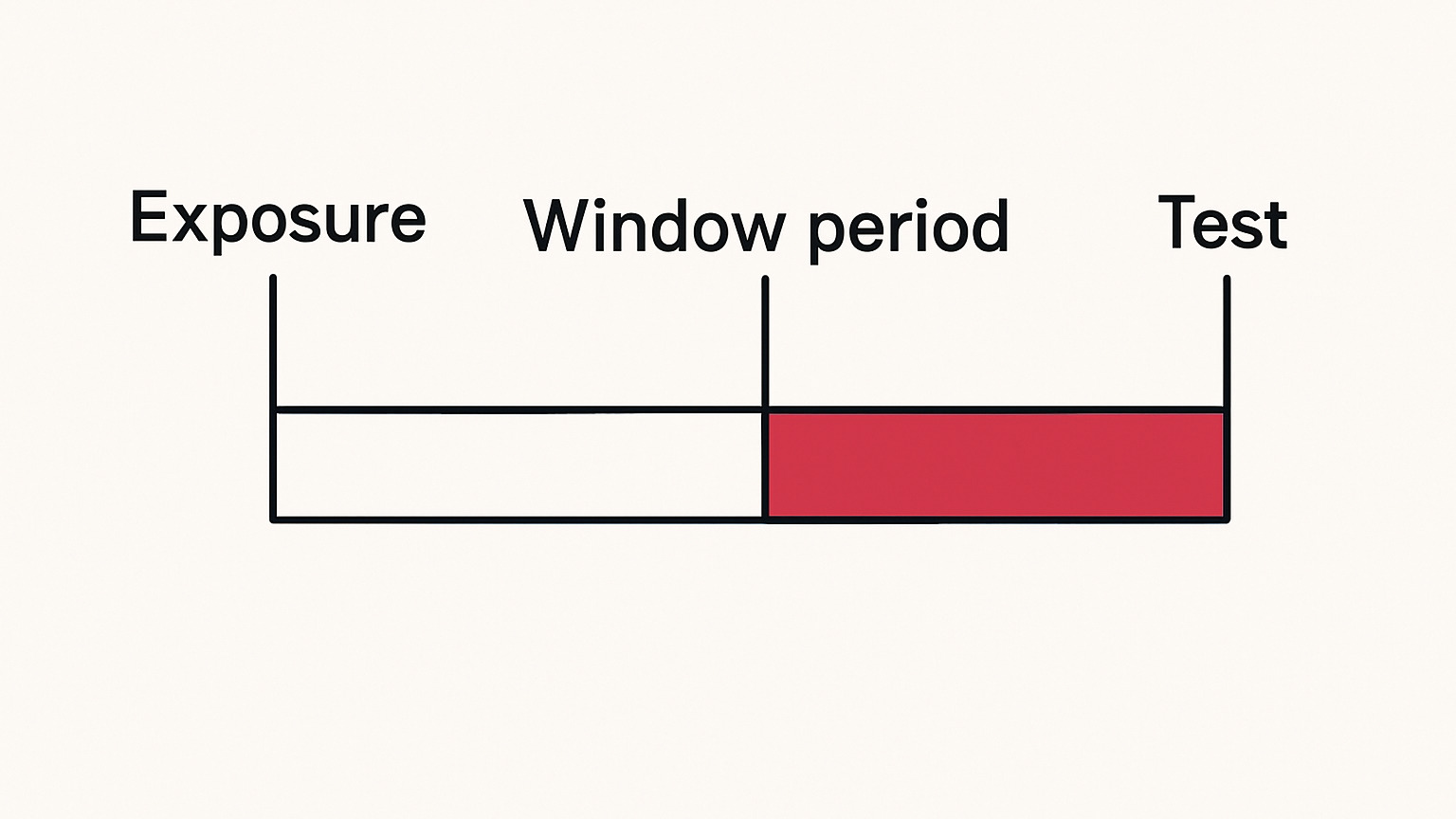
Because a test detects the organism or your response to it, which takes time to become reliably measurable. Symptoms can appear before a test is conclusive, and a negative test taken too early means nothing. The two timings answer different questions.
What are the testing windows?
Two weeks for chlamydia and gonorrhoea. Forty-five days for a fourth-generation laboratory HIV test. Twelve weeks for syphilis and for hepatitis B and C antibodies. Ninety days for an antibody-only self-test.
Should you wait for symptoms?
No, and this is the practical conclusion. Since most infections produce none, waiting means carrying something silently and passing it on. Screening every three months at every site, or after a specific exposure at the intervals above, is what actually finds things.
What if symptoms appear before the window closes?
Go anyway. Symptoms are assessed and frequently treated on clinical grounds without waiting for results, and the window applies to ruling something out rather than to finding it.
Is it worth noting when something started?
Yes. A clear timeline is one of the most useful things you can bring to an appointment, since timing drives which tests are relevant and whether anything with a window still applies.
The short answer
Days to weeks if they appear, and usually they do not. Test on a schedule rather than in response to how you feel.
What if symptoms appear a long time later?
Common with syphilis, which progresses in stages over months and years, and with hepatitis. It also means an infection acquired long ago can surface now, so a recent encounter is not necessarily the source. The clinic will work out the likely window for notification.
Do symptoms mean a higher viral load or a worse infection?
Not reliably. Symptoms reflect how your body responds rather than how much infection is present, and silent infections do the same damage. This is why symptom-watching is such a poor substitute for screening.