Self-taken rectal swabs perform as well as swabs taken by a clinician, which is why UK services have almost entirely moved to them. They take under a minute and are not painful. The technique matters, though, because the most common reasons a result is unreliable are a swab that never reached the rectal lining and a swab that spent too long somewhere it should not have.
The technique
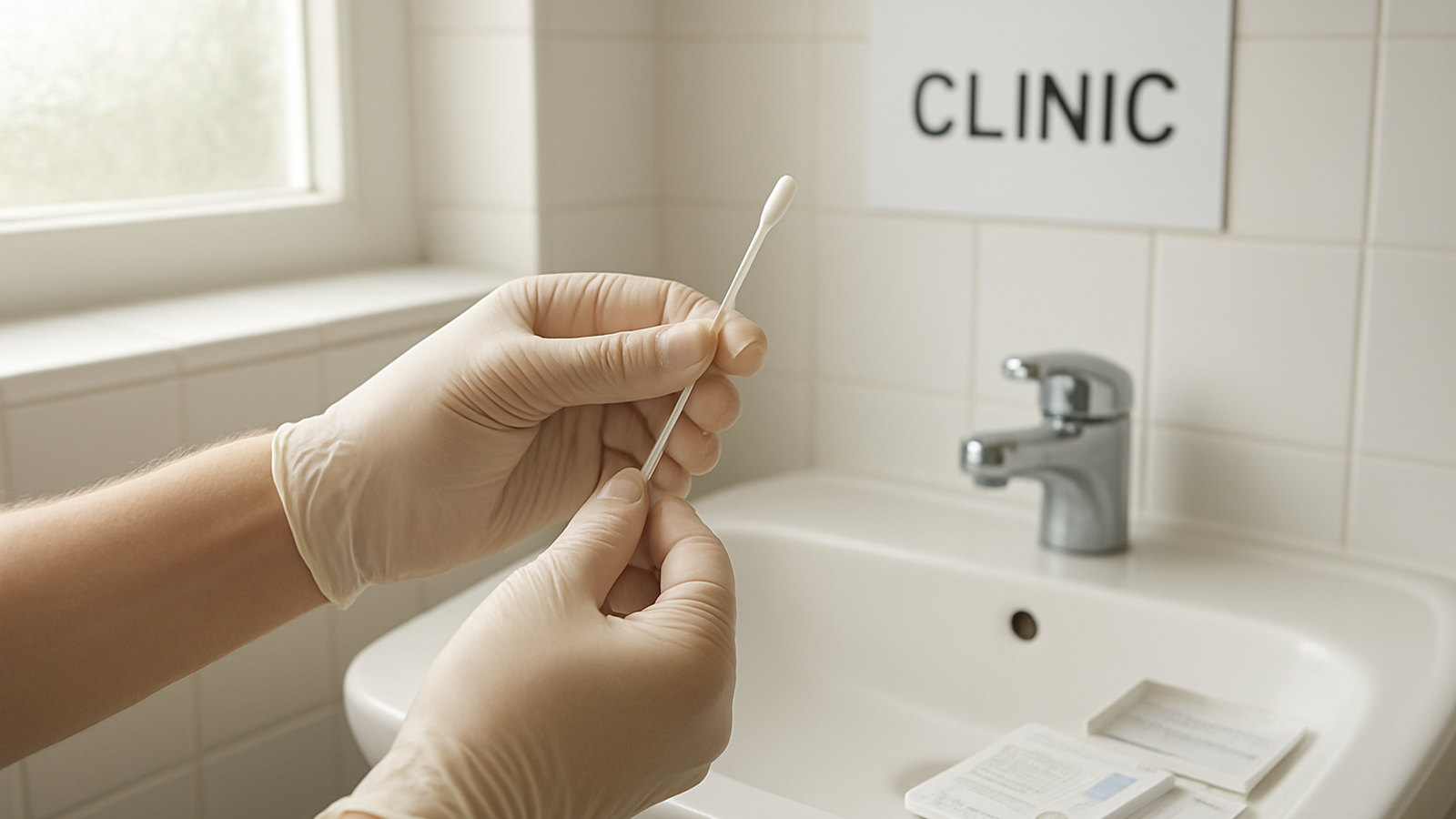
Wash and dry your hands. Open the packet at the handle end and avoid touching the tip against anything, including your fingers, skin, clothing or the sink. Standing with one foot raised, squatting, or sitting on the toilet all work, and it is worth choosing whichever lets you reach comfortably. Insert the swab roughly three to five centimetres into the anus, which is about the length of the tip and a little more, and rotate it gently against the wall of the rectum for about ten seconds. Withdraw it without touching the outside skin, place it into the tube, and snap or cut the handle at the marked line so the lid closes properly.
What are the common mistakes?
Not going far enough in is the main one, since sampling the anal margin rather than the rectal lining collects the wrong cells. Touching the tip against skin or a surface before insertion contaminates it. Failing to rotate means you may collect nothing even at the right depth. Forgetting to break the shaft means the cap will not seal and the sample leaks in transit. And leaving the tube unlabelled, or mixing up which tube is which, invalidates the whole kit, which is a genuinely common problem when three swabs arrive in one box.
Does it matter if there is stool on the swab?
A small amount of faecal material is normal and does not usually stop the laboratory processing it. Heavy contamination can interfere, so if the swab comes out visibly loaded it is worth using a fresh one where the kit allows. Do not wash the swab or wipe it clean, since that removes the sample.
Should you douche first?
No. Douching before a swab is counterproductive: it washes away the cells and organisms the test is looking for and can cause enough irritation to affect the sample. Take the swab before any cleaning routine, or on a day you have not douched at all. The same applies to lubricant, which should not be used on the swab because some formulations interfere with the test.
Does it hurt?
It should not. There may be a brief sensation of pressure or an urge to open your bowels, which passes. If it is genuinely painful, stop, because pain on insertion suggests a fissure or active proctitis, and that is a reason to be seen in person rather than to push through it. Significant rectal pain warrants an appointment rather than a postal kit.
Does timing matter?
Less than for urine samples, which need at least an hour since you last urinated. For a rectal swab, taking it before a bowel movement rather than immediately afterwards gives a slightly cleaner sample, but this is a refinement rather than a requirement. Post the kit back the same day if possible, since samples degrade the longer they sit.
Why bother, when there are no symptoms?
Because rectal gonorrhoea and chlamydia are silent in the great majority of cases, and a urine sample cannot detect them. If you have receptive anal sex, the rectal swab is the single most likely part of the kit to come back positive. Skipping the swab that feels awkward is how people test regularly for years and still transmit an infection they never knew about.
What about the other samples in the box?
The same principles apply. A throat swab needs firm contact with both tonsils and the back of the throat rather than a nervous dab, and it will make you gag briefly. A urine sample should be the first part of the stream, ideally at least an hour after you last urinated, since a recently flushed urethra gives a poor sample. Label each tube as you finish it rather than at the end, because three identical tubes are very easy to mix up.