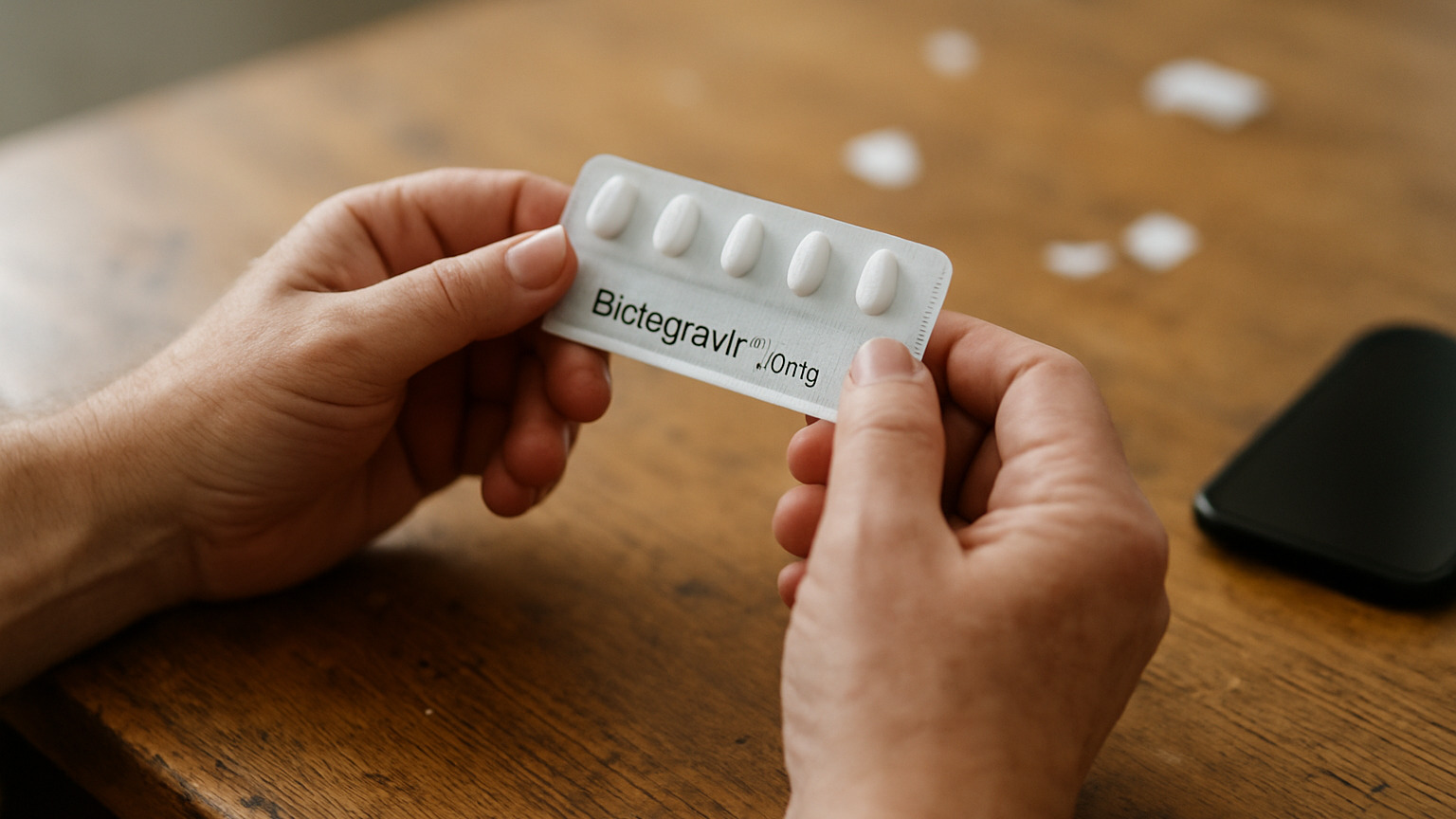
Bictegravir has the simplest dosing picture of any drug on this site. There is one product, one strength and one schedule.
What is the product?
A single tablet containing bictegravir 50mg, emtricitabine 200mg and tenofovir alafenamide 25mg, branded Biktarvy. There is no standalone bictegravir tablet and no other combination containing it.
What is the dose?
One tablet once daily. That is the entire regimen; nothing else is needed alongside it. It is one of a small number of complete single-tablet treatments.
Can the dose be adjusted?
No. There is no alternative strength and the tablet cannot be split, since it contains three drugs in fixed proportions. Where a lower dose of any component would be needed, the answer is a different regimen entirely.
What about kidney impairment?
It is not recommended below a certain level of kidney function, because the tenofovir alafenamide component requires it. Because the dose cannot be adjusted, someone whose function falls below that threshold is switched rather than reduced.
What about liver impairment?
No adjustment for mild to moderate impairment. It is not recommended in severe hepatic impairment, where it has not been adequately studied.
Why is there no separate bictegravir tablet?
A commercial decision rather than a clinical one. It limits flexibility: where someone needs the integrase inhibitor but not the other two components, dolutegravir is used instead because it is available separately and in several combinations.
Are there generics?
Not currently in the UK, since it is a newer product still under patent. That affects cost to the NHS rather than cost to you, since HIV treatment is free at the point of use.
How is it supplied?
Monthly or three-monthly through an HIV clinic pharmacy, free and without a prescription charge. Longer supplies can generally be arranged for travel if you ask in advance.
What about children?
Lower-strength formulations exist for children meeting weight criteria, prescribed under specific paediatric guidance.
Does the tablet need anything with it?
No other medicine. It does need attention to timing around antacids and mineral supplements, which bind the bictegravir component and reduce absorption.
Does a single-product drug create supply risk?
In principle, since there is no alternative manufacturer to fall back on. In practice UK supply has been reliable. If a shortage ever arose, the answer would be switching to a dolutegravir-based regimen rather than going without.
What should you know about the tablet itself?
It is relatively small, which people appreciate, and it should be swallowed whole rather than crushed unless you have been told otherwise.
What if a supply looks different?
Since there is currently one manufacturer, variation is less likely than with generics. If something looks unfamiliar, ask the pharmacy to confirm rather than assuming an error or not taking it.
Does the pill burden matter?
Considerably, in practice. Fewer tablets is associated with better adherence, which is why single-tablet regimens are preferred where they suit. If the number of things you take with bictegravir is putting you off, say so, since simplification is frequently possible.
What about travelling with it?
Keep bictegravir in its original packaging, in hand luggage rather than the hold, and take more than the trip requires. A letter from your clinic is worth having for longer journeys, and it is worth checking rules for your destination.
What should you check on the label?
The name, the strength and the number of tablets per dose, particularly after any change of regimen or supplier. Errors are rare and they happen, and thirty seconds checking is worth it.
Can you take it at a different time each day?
Better to pick one and keep to it. Variation of an hour or two is immaterial and consistently taking bictegravir at wildly different times usually signals a routine that is not working, which is worth fixing before doses start being missed.
What about repeat prescriptions?
HIV medication is usually issued by the clinic rather than a GP, which means the timing is tied to your appointments. Ask for a longer interval if collecting monthly is difficult, since most services can accommodate three-monthly supplies.