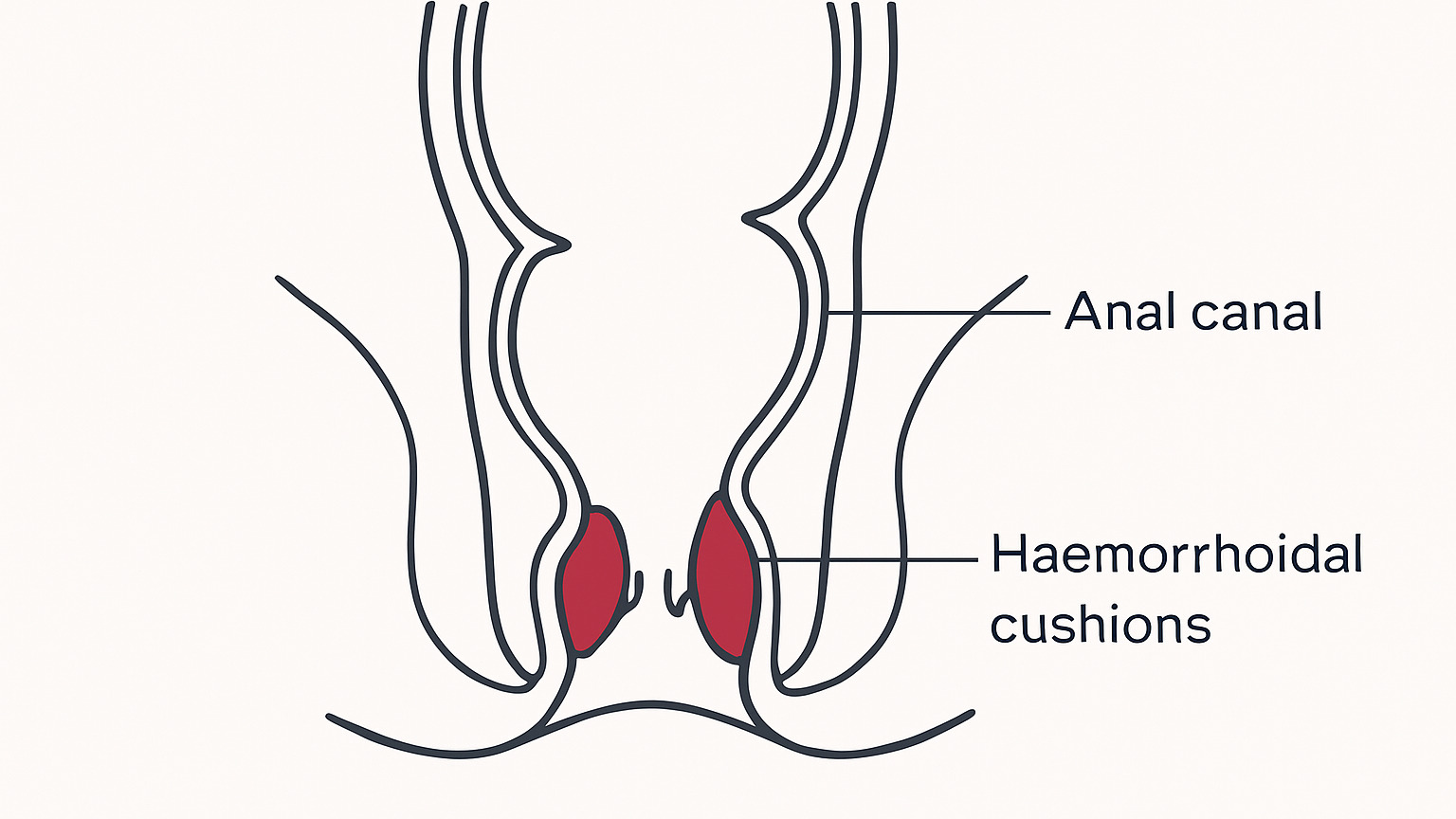
Haemorrhoids are swollen blood vessels in the anal canal, and they are caused by sustained pressure rather than by sex. Straining on the toilet, chronic constipation or diarrhoea, long periods of sitting, heavy lifting and being significantly overweight are the usual contributors. Anal sex does not cause them, though it can irritate existing ones and make them bleed or swell.
What do they feel like?
Internal haemorrhoids typically cause painless bright red bleeding, noticed on the paper or on the surface of the stool, sometimes with a feeling of incomplete emptying. External ones cause itching, a soft lump you can feel at the anal opening, and discomfort when sitting. A thrombosed external haemorrhoid, where a clot forms inside it, is a different experience entirely: a firm, exquisitely painful blue-purple lump appearing over hours, which is unpleasant but not dangerous and settles over a week or two.
How do you tell them from a fissure?
The pain pattern separates them. A fissure produces sharp, tearing pain at the moment of passing stool that then aches for hours. Haemorrhoids are more often itchy or achy than sharply painful, and internal ones frequently produce bleeding with no pain at all. If passing stool feels like passing glass, it is more likely a fissure.
What actually helps?
The same measures that help a fissure, for the same reason. Increase fibre gradually with water alongside it, aiming for stools that pass without straining. Do not sit on the toilet for long stretches, since that is a genuine cause rather than a coincidence. Warm baths relieve discomfort. Over-the-counter creams and suppositories from a pharmacy reduce itching and swelling and are reasonable for a week or two, though they treat symptoms rather than the cause.
Does receptive sex make them worse?
It can, particularly during a flare, and bleeding after sex from existing haemorrhoids is common. Plenty of lubricant, a slower pace and avoiding it entirely while one is thrombosed or actively inflamed are sensible. There is no evidence that receptive anal sex causes haemorrhoids in the first place, so this is about managing a flare rather than a reason to stop permanently.
When do you need a procedure?
If bleeding, prolapse or discomfort persist despite several weeks of the measures above, a GP can refer you. Rubber band ligation is the most common outpatient treatment for internal haemorrhoids and is quick, done without anaesthetic and generally effective. Other options include injection sclerotherapy and, for larger ones, surgery. None of this is urgent unless you are bleeding heavily.
What should not be assumed to be haemorrhoids?
This is the important part. Rectal bleeding is very commonly haemorrhoids and occasionally something else, and the something else matters. Proctitis from gonorrhoea, chlamydia, lymphogranuloma venereum, herpes or mpox produces bleeding with discharge, pain and an urge to open your bowels, and needs a swab rather than a cream. Bowel cancer becomes more likely with age and presents with bleeding, a change in bowel habit lasting weeks, weight loss or bleeding mixed through the stool rather than on its surface. Self-diagnosing years of bleeding as piles is a well-recognised way of arriving late.
When to get it looked at
See a GP for bleeding that persists beyond a couple of weeks, any bleeding if you are over forty or have a family history of bowel cancer, blood mixed into the stool, a change in bowel habit, unexplained weight loss, or bleeding with pain, fever or discharge. A quick examination settles most of these, and being examined is considerably less unpleasant than the alternative of waiting.
What about a thrombosed haemorrhoid?
This is the one that sends people to A&E, and while it is genuinely painful it is not dangerous. A firm purple lump appears over hours and is most painful for the first two or three days. Pain relief, warm baths and time resolve it, and the lump gradually shrinks over a couple of weeks, sometimes leaving a small skin tag. If it is seen within the first day or two, a clinician can occasionally drain it under local anaesthetic, which relieves the pain quickly.
Do skin tags need removing?
No. Skin tags left behind after a haemorrhoid or fissure has healed are harmless and removal is usually cosmetic rather than medical. They can make cleaning slightly more awkward, which is worth mentioning if it bothers you, but they do not require treatment.