The dosing schedule depends on what kind of sex you are having rather than on your gender, and for most trans people the answer is daily. The event-based schedule that works for anal sex has not been established for other kinds, and treating it as universal is a real gap in protection.
What is the event-based schedule?
Often called two-one-one: a double dose two to twenty-four hours before sex, then one dose twenty-four hours later and one more twenty-four hours after that. The evidence supporting it comes from studies of anal sex between cisgender men, and it is well established for that use.
Why is daily recommended otherwise?
Because tenofovir reaches protective concentrations in rectal tissue considerably faster than in vaginal or frontal tissue, where around seven days of daily dosing is needed. A schedule that protects one site does not automatically protect another. For frontal sex, the answer is daily with a seven-day lead-in, and there is no shortcut.
What about trans women having anal sex?
The evidence base for event-based dosing in trans women specifically is thin, and UK guidance generally recommends daily dosing rather than extrapolating from studies that did not include trans participants. Daily also removes the counting, which is the practical failure point for most people.
What about a neovagina?
Tissue after vaginoplasty behaves differently again, and there is very little research on drug concentrations there. Daily dosing is the recommendation, and anyone being told otherwise is working ahead of the evidence rather than from it.
How do you start?
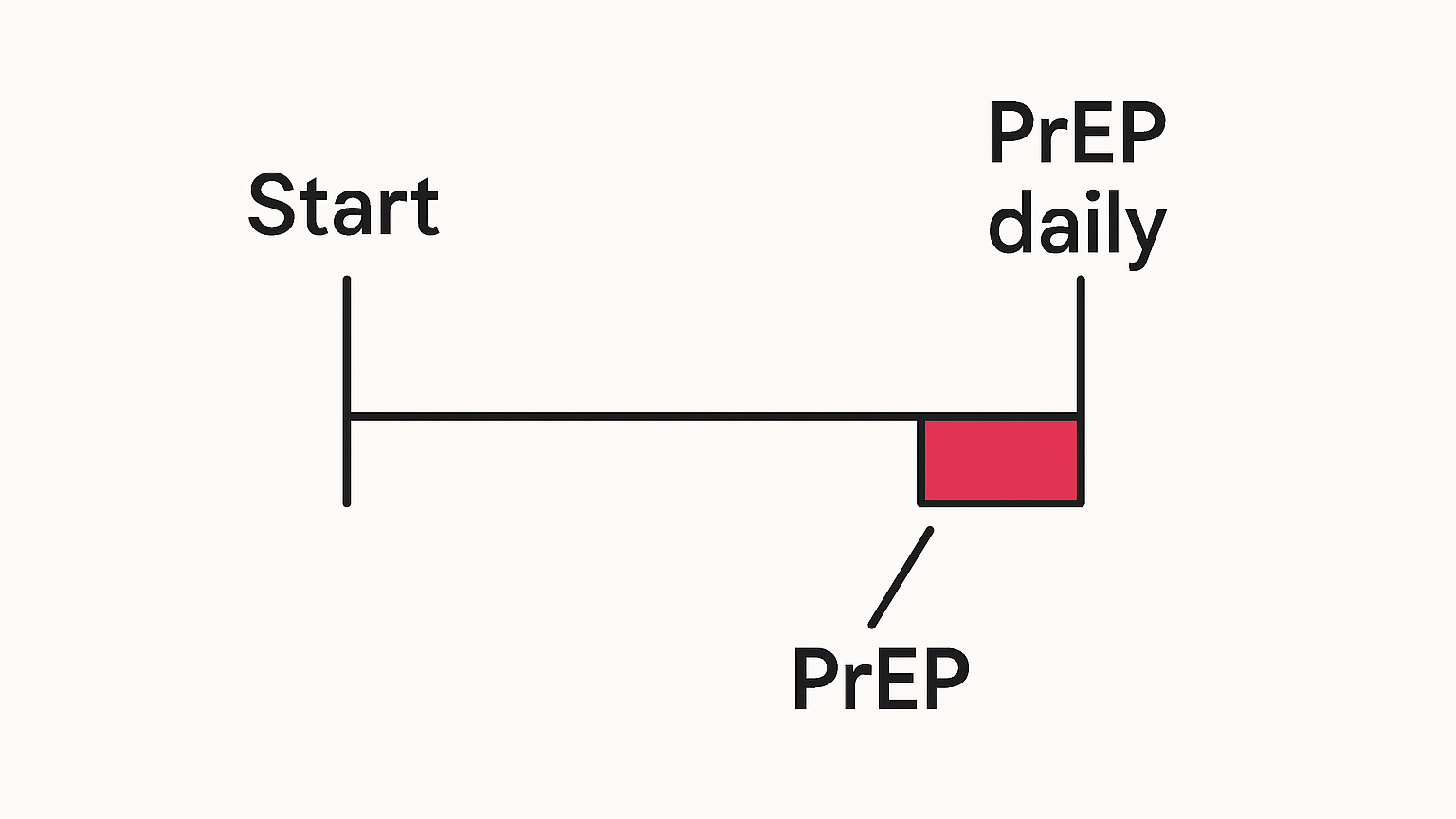
For anal sex, either seven days of daily tablets or a double loading dose two to twenty-four hours beforehand. For frontal or neovaginal sex, seven days of daily dosing, with no loading shortcut. Starting the day of a planned encounter does not protect you for frontal sex.
How do you stop?
Do not simply stop on the day. After anal sex, continue for two days past the last exposure. After frontal sex, continue for seven days. If you have chronic hepatitis B, stopping abruptly can cause a flare and needs planning with your clinic rather than deciding alone.
What about missed doses?
Daily dosing tolerates the occasional miss better than the event-based schedule tolerates any. If you take hormones daily, attaching PrEP to the same moment is the most reliable approach available, and people who do this report far fewer gaps.
Does it interact with hormones?
No, in either direction. This is the most common reason trans people avoid PrEP and the evidence does not support it. Adherence rather than pharmacology explains the lower effectiveness seen in some studies.
What else comes with it?
Screening every three months at every site you use, kidney function monitoring, and the chance to sort out vaccinations. The screening is arguably worth as much as the PrEP, since it catches the infections PrEP does nothing about.
What about injectable PrEP?
Given every two months and worth asking about if daily tablets are difficult. UK availability is still developing and eligibility varies by area.
What is the practical summary?
Daily, started seven days ahead if frontal or neovaginal sex is involved, taken alongside your hormones, with a two or seven day tail when you stop.
What if you have several kinds of sex?
Take the most protective schedule that covers all of them, which in practice means daily. Trying to switch between schedules according to what is planned is how gaps appear, and the plan frequently changes.
Does it protect against anything else?
No. PrEP covers HIV only and does nothing about gonorrhoea, chlamydia, syphilis, herpes, hepatitis or mpox. The three-monthly screening that comes with the prescription is what covers those, and it is worth using fully.