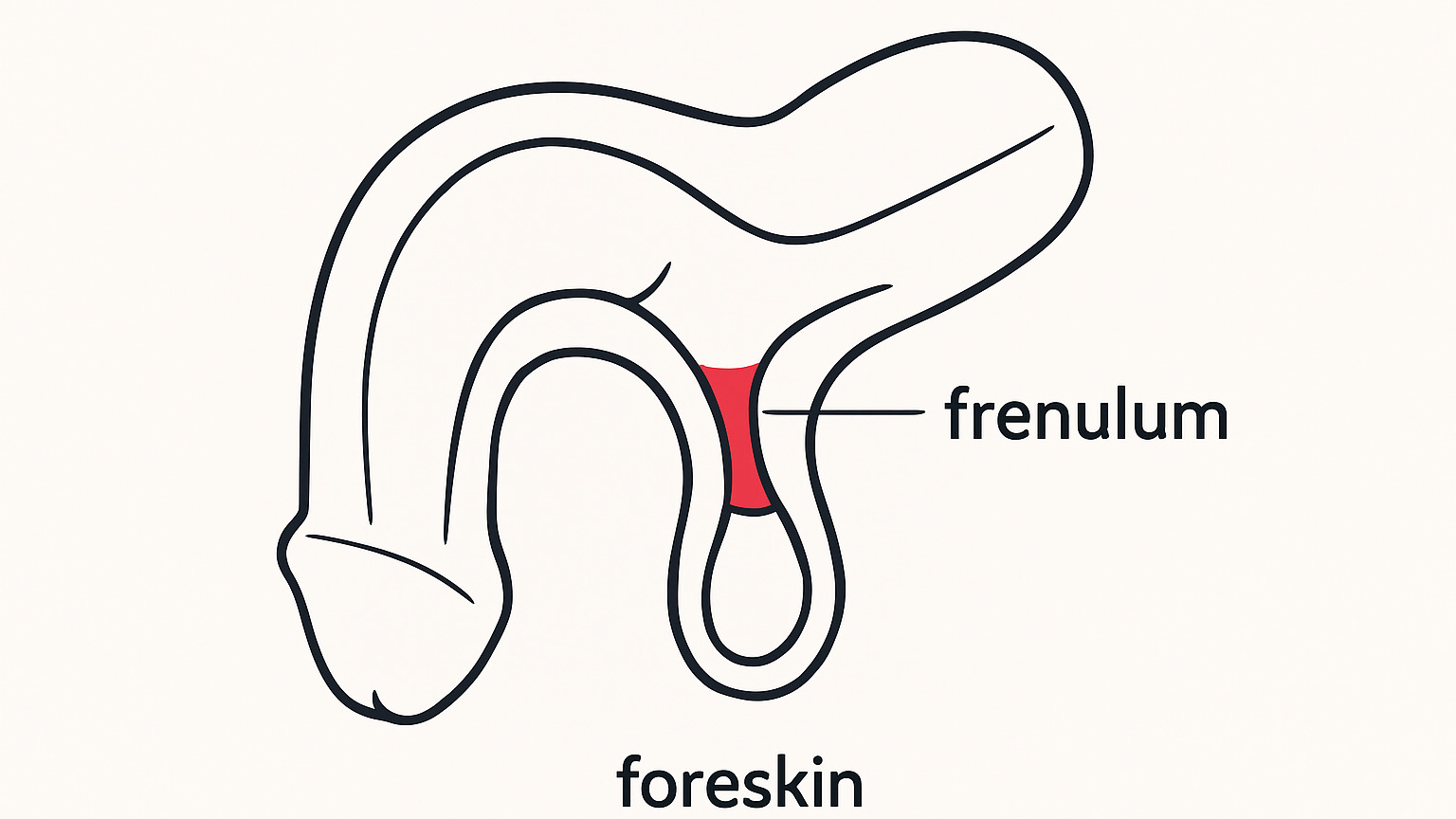
Almost everything written about aftercare addresses the receptive partner, which leaves a set of common problems unmentioned. Friction injuries, tears and foreskin complications affect the insertive partner regularly, and one of them is a genuine emergency.
Friction injuries
Soreness, redness and small splits on the shaft or around the head, caused by the same thing that causes them at the other end: not enough lubricant and too long a session. They settle over a few days. Keep the area clean with water only, avoid soap, and leave it alone rather than applying anything.
A torn frenulum
The band of tissue on the underside of the head tears relatively easily during vigorous sex and bleeds more than the injury warrants, which is alarming. Apply firm pressure with a clean cloth for ten minutes without lifting to check. Most stop. If bleeding continues beyond twenty minutes of pressure, or restarts heavily, go to an emergency department. Avoid sex until it has healed, which takes a week or two, and use considerably more lubricant afterwards since it tears again readily.
Paraphimosis
The one that is urgent. If the foreskin is retracted and then cannot be pulled back forward, it can constrict and cause swelling that worsens over hours. This is a medical emergency and needs an emergency department the same day, not the morning after. Prevention is straightforward: always return the foreskin to its normal position after sex, after washing and after putting on a condom.
Balanitis
Inflammation of the head of the penis, causing redness, soreness, itching and sometimes discharge under the foreskin. Frequently caused by soap, shower gel or a lubricant rather than by infection, and often resolves by washing with water only and drying properly. Persistent cases need a clinic, since thrush and bacterial causes are also common and are easily treated.
Urethral symptoms
Burning when passing urine, discharge, or irritation at the tip after receptive oral sex or insertive anal sex points towards gonorrhoea, chlamydia or Mycoplasma genitalium rather than friction. A urine sample settles it. Repeatedly squeezing the urethra to check for discharge causes irritation and produces fluid, which then confirms the worry.
What about condoms?
Latex irritation, spermicide and high osmolality lubricants all cause soreness that people attribute to infection. Switching to a plain condom with a separate low osmolality lubricant resolves a good deal of it. Spermicidal condoms should be avoided entirely.
What about hygiene?
Rinse with water, including under the foreskin if you have one, dry gently, and return the foreskin forward. Avoid soap on the head of the penis, which is one of the most common causes of persistent soreness.
Does the insertive partner need testing differently?
Urine and throat samples are the relevant ones, plus blood tests for HIV and syphilis. A rectal swab becomes relevant the moment roles change, which happens more often than people plan for, so screening every site you use rather than every site you usually use is the version that catches things.
What needs urgent attention?
A foreskin that will not go forward. Bleeding that will not stop with pressure. Sudden severe pain or swelling in one testicle, which can be torsion and has a window of hours. Inability to pass urine.
What is worth remembering
Being the insertive partner is not a role without aftercare, and the injuries it produces are just as worth attending to.
What about emotional aftercare?
Frequently overlooked entirely. The person in the more active role has had the same adrenaline and often carried responsibility for someone else's wellbeing, and top drop is real. Nobody asks, partly because the intensity is assumed to have been one-directional. Checking in runs both ways.
Does anything reduce friction injuries?
The same things that help the receptive partner: considerably more lubricant, reapplied during rather than only at the start, and a low osmolality product. A drop inside the tip of a condom before rolling it on reduces friction against the head and improves sensation at the same time.